
Bottom line… Of course not!…
The first guitar I ever really learned to play on was a Fender Squire, made in Japan. I loved it, but for some incredibly “less-than-intelligent” reason, I got rid of it. I used it, and another guitar as a trade-in for (what I thought) was a better guitar.
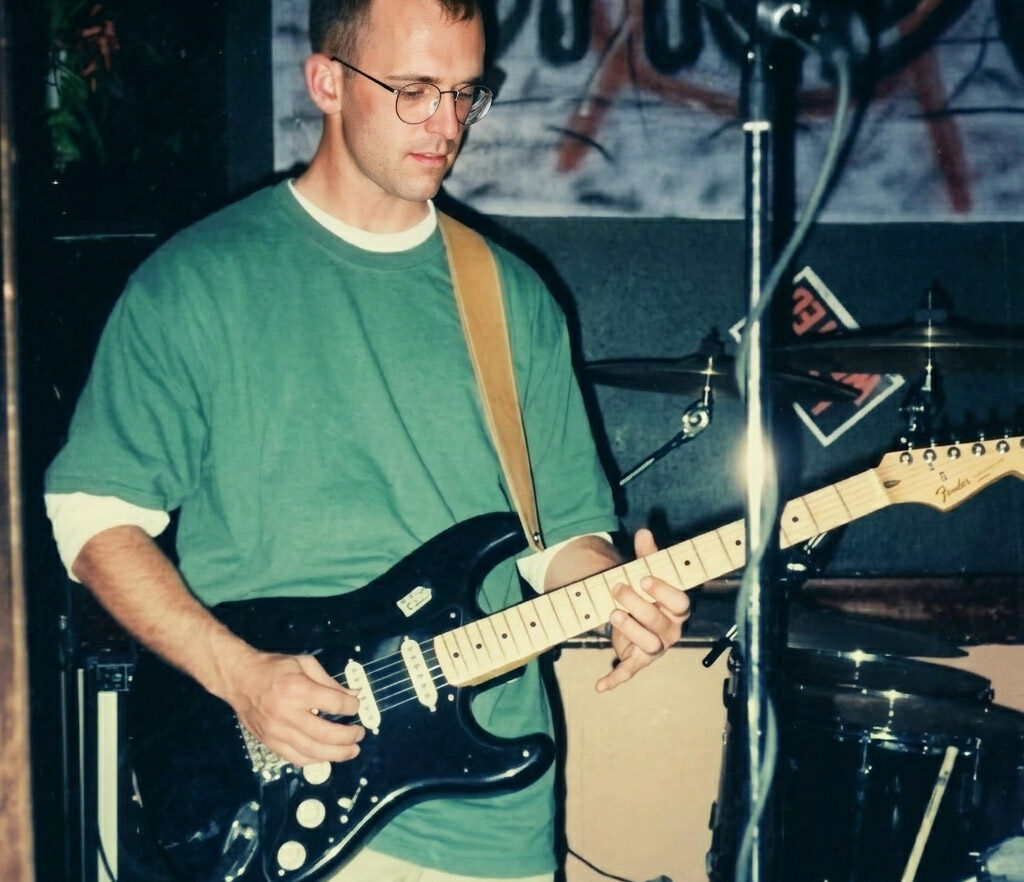
Photo Caption: My Fender Squire Electric Guitar (Made in Japan) – Playing on stage in Sierra Vista, Arizona – Photo cleaned up by Gemini Images (NB?) – Old, noisy photo from the late 90’s…
Technically, it was a better guitar. It was a Paul Reed Smith (PRS) McCarty; however, I should have been more patient and not given up a piece of my musical history.
Key takeaway: The skill and personality of the guitar player are more important than the brand or where it was made, at least in the initial comparison.
The pride of owning an “American Guitar.”
I was excited that I could now own an “American-made,” “respectable” electric guitar. But I was used to playing the Squire more so than the McCarty, which definitely required some getting used to. It (as some of you know) had a much thicker neck, which made me develop a slightly different playing style. I’m referring to it in the past tense (“It had”) because I eventually sold the PRS as well. Luckily, over the years, I’ve managed to keep at least a few in my possession; however, the ones with sentimental value are unfortunately long gone…
Sometimes you may think you’re buying American.
One of my later-in-life guitar purchases was a Gretsch White Falcon (G6136TG). I had never really played or even looked into Gretsch guitars before; however, I certainly always thought the higher-end ones were made in the U.S.A. … Well, maybe in the $8,000+ range (i.e., their Custom Shop Guitars), but my $3,500 Falcon is not. It’s made in Japan. Imagine my surprise when I looked at the back of the headstock… I didn’t even think to ask before purchasing.
I just assumed it was made in America. Of course, nothing is wrong with items made elsewhere—most things Americans use daily are imports. Still, for musical instruments, my preference leaned toward American-made. Yet, this Gretsch has quickly become one of my favorites. It looks and, more importantly, plays wonderfully! I no longer judge a guitar by its country of origin.
Another thing to consider about American-made guitars
Exceptional-quality American-made guitars will also have an “exceptional price tag,” in most cases. I also own a Gibson 1956 Gold Top Re-issue (about $1,000 more than the Gretsch), and right out of the box, the Gretsch played and felt much better than the Gibson. Now, I know one’s a semi-hollow body and the other a solid; however, I’m just comparing the price versus playability.
The Gretsch White Falcon, despite the Bigsby Tremolo, stayed in tune much better than the Gold Top, and the action was set pretty much right on (for me anyway). [The Bigsby Tremolo is a wonderful piece of gear, by the way, you just have to watch your tuning with any tremolo system.] Now… Does this mean I will not buy a $3,000–$5,000 Gibson ever again?? Of course not.
Despite the guitar, once set up properly, most decent guitars will play and sound much better anyway. Besides, the Gibson 1956 Gold Top Reissue has a nice, deep sound compared to the Gretsch, and so it will be needed on occasion. It’s like what’s been said millions, upon millions of times: “There’s a guitar for every song…”
American-Made Guitars are NOT the “end-all, be-all” of guitars.
I simply want to stress that I now respect “foreign-made” guitars much more, and the manufacturing country is no longer the deciding factor for my future purchases.
Of course, it would always be best if you could play a guitar before a purchase, and sometimes you’re able to. I certainly hope so if it’ s an expensive one. However, with enough research and YouTube videos, we can nowadays get a good idea of what a guitar would be like before purchasing it, without having touched it first.
“Foreign-Made” is ok with me.
A more recent acoustic guitar I purchased, based on recommendations from a few people on social media, was an Orangewood Oliver M acoustic guitar made in Indonesia. I think I paid $250-$350 for it, and it sounds wonderful (for the price). The playability is quite nice as well.
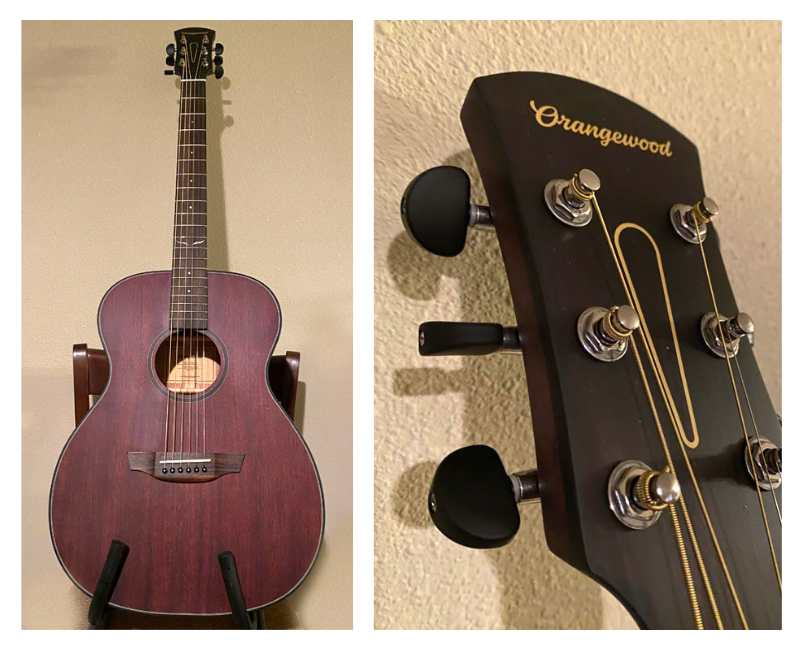
Photo Caption: Orange Oliver M Acoustic Guitar
More Guitar Photos From My Flickr Album
The action is a little high, and the high E string (once tuned to standard tuning) has acquired a sitar-like sound when played open (I’ll try to get that fixed at some point). But again, for the price, I was amazed at the tone it produced…
In Conclusion
Key takeaway: When buying a guitar, focus on its features and playability, not its country of origin. Sound, feel, and personal connection matter more than national pride in ownership.
Not that I’ll never buy American again. I’d love to add a couple of PRS back to the collection, for example. But at the end of the day, I believe country of origin should be low—if not secondary—on your list of priorities when choosing your next guitar.
Until Next Time,

Special Note: The first guitar I ever played was actually some no-name white guitar, which I did love and appreciate… It’s just that I never got to the point of actually understanding what I was playing until after owning and playing the Fender Squire for a while… The “first” guitar is actually still in the possession of a friend of mine, so I guess I haven’t lost “The First Guitar”… But, the Squire saw much more stage time and had a great deal of learning history attached to it…
Featured Image: My Gretsch White Falcon. Definitely at the top of the list of my favs… View on Flikr.